Monday, April 15, 2013

Adopted Thought

The first thing you need to know about Yoshimi, as featured in Yoshimi and the Shadow Clan, is that she's an orphan.  I am not an orphan myself.  I can understand, though, not just because they're a common trope in fiction, but because they're ultimately alienated individuals, who either lost or never knew their birth parents.  The ones who don't end up in foster homes are especially alienated.  We have families as a social rule for a reason, because they're the first best way to understand why it means to live in society.

The aspect of the orphan mindset that Yoshimi most closely embodies, however, is adopted thought.  I define adopted thought as thought that is not native to oneself but rather learned from someone else.  Some people live their entire lives subsisting on adopted thought.  It's just easier to accept what someone else has told you to believe about something.  Original thought is rare.  Adopted thought is not inherently bad.  Some people will just naturally assume that what they consider their original thought is in fact adopted thought.  They internalize the behavior they observe in others.

This is a matter of the old nature vs. nurture debate.  In psychology this is the phenomenon of determining how much of a person's psyche is determined internally and how much externally, or in other words learned or inherent behavior.  Did you get it from someone or did it develop of its own accord?

To an orphan like Yoshimi, this is very much a pertinent question.  From the perspective I took, she would be rebellious of all attempts to be placed in a foster home (which she fights against through thirty-six of them) because it would be like replacing her parents.  How, then, would she know if anything that she becomes is from herself and her dead parents, and how much from the strangers who took her in?  She's afraid of losing a link that only exists now in her mind.

Yet as the story develops she's told that everything she is, all her instincts, have been inherited from her parents, abilities she never knew she had but she's been using unconsciously all her life.  Studies on twins, who have the exact same genetic material, have shown that when they're separated and raised in different environments develop, in fact, differently.  I wasn't interested in taking a strictly scientific approach.  Biologically we undoubtedly inherent certain genetic traits, obvious ones like facial structure, hair color, body type.  The children of famous individuals often have a hard time living up to their parent's achievements, but a lot of that is simply the typical impossibility of facing pressure of that kind directly.  Yoshimi is in the unique position of doing exactly that but without the pressure.  Although since most of the people she subsequently encounters knew her parents, it's simply a matter of her own necessary ignorance.

When faced with a blank slate but a given set of art supplies, there's only a matter of variance.  That's the story of writing.  No matter how different, every story is the same, and it's a fool's errand to try and prove differently, much less rebel and deny and reject.  In Shadow Clan Yoshimi encounters James Peers, who refuses to teach her traditional martial arts methods because he believes in a holistic approach, or in other words the nurture approach by way of nature, absorbing what will develop as it's experienced, using one's own instincts to take whatever form will develop.

In adopted thought, it's simply a matter of learning.  That's what education is all about in school, taking what's given you without question.  In original thought, it's an interactive experience.  You accept and reject and modify as you deem necessary.  Truth is not always obvious, even when it seems that it is.

The natural instinct of any guardian is to assume that the person you're taking responsibility for needs your guidance.  If someone like Yoshimi doesn't believe that, or fears it, then there's very little to be gained by the experience.  She's an orphan because that's what she is and what she believes she must continue to be.  There was always the chance that a family may have presented itself that broke all her barriers.  In fact, the complete story is all about how the people she meets end up being a different kind of family.  They're all struggling against each other, but the real trick is that they don't let that get in the way.  That's the true definition of family.

I have a problem with people who rely on adopted thought.  I think it always shows, and it's damn depressing, because they never realize it themselves.  It's not always a bad thing, but it's a phenomenon that causes more trouble than it's worth.  Yes, it helps everyone function in a common direction, but it's also distrustful of dissenters, and that's never a good thing.  You don't always need a sword to confront it, and maybe Yoshimi's real story is that she's awash in a sea of original thinkers who are all struggling against adopted thought.

Please note that I'm not arguing against foster homes or adoption, but rather the belief that it's okay to deny the identities of those who are entered into these equations.  It only ever causes trouble.  That's exactly what Yoshimi believes, and most of this is merely subtext.  The story of Yoshimi is a metaphor for how tough life can be in any context, no matter what you believe or what you're struggling against.

***

Please note that I'm writing about Yoshimi, as well as the Space Corps, all month long over at Scouring Monk as part of the A-to-Z Challenge.

Monday, April 8, 2013

(Formerly) Secret Origins of Yoshimi

All month long I'm participating in the A-to-Z Challenge over at Scouring Monk, talking about both the Space Corps saga and the Yoshimi Trilogy.

Today, as the title suggests, I'm going to drop some background knowledge on you.  I've previously done that here with Seven Thunders, where I explained how the neglected War of 1812 helped inform the structure of the story.  I like to do that in my fiction.  When I was writing The Cloak of Shrouded Men, specifically the individual installments Colinaude, the Angry Avenger (2004), Repose of the Eidolon (2005) and Cotton's War (2006) during NaNoWriMo, I would conclude each month by explaining the latest influences.  It was a fine way to finish writing a long work.  The entire back section of the Cloaked book is filled with a version of what I wrote in that regard.

Well, the story of warrior orphan Yoshimi was not something that came naturally to me.  I don't do action very well.  I write about the effects of a situation more than the situation itself, or in other words from a very cerebral vantage point.  In fact, the start of this secret origin perhaps shouldn't be so secret.  It's very much the story of another effect, the Flaming Lips album Yoshimi Battles the Pink Robots.  It was my introduction to concept albums, my generation's very own.  If you've never heard it, I feel bad for you.  Anyway, that's the most superficial of secret origins to explore.

Another informs an entire element of the story.  Remember how I said I'm not much of an action writer?  Since Yoshimi by definition had to experience a lot of action, I had to come up with a more cerebral approach, and I stumbled into that approach because at the time I was developing the story I was working in a bookstore.  It was Hiroshi Moriya's The 36 Secret Strategies of the Martial Arts, a kind of Art of War for those of us looking to be more clever about it.  Each of the strategies are employed and quoted during the course of the story, and the specific number of them affected the story, too, including the number of foster homes Yoshimi endures early in her life and the key battles that must occur in order for the story to conclude (sort of like a video game!).  Additionally, I honored Moriya himself as a character; the book as a present Yoshimi receives; and the translator of the edition I purchased, William Scott Wilson, who ended up inspiring a character more important than Moriya's (although in the story one succeeds the other once again).

The final element is the final acknowledgement that, again, I am not a writer of action.  It was the movie Warrior, released in the fall of 2011, when I began writing the story.  Warrior is a movie about MMA (mixed martial arts) fighting, but it's not really about the fighting.  It stars Tom Hardy, who wins a lot of his fights without really having to try.  That was the pattern by which I had Yoshimi fight.  It was a clever way to avoid having to write a lot of intricate fight scenes.  Warrior, by the way, quickly became one of my favorite movies.  It's awesome in every way possible.  It also ended up affecting how I concluded Seven Thunders.  So, a very influential movie in my writing!

But again, if you're curious about the Yoshimi Trilogy, you should also be reading Scouring Monk this month.

Thursday, April 4, 2013

Friday is Free Day!

During the Fridays of April several of my books will be free in their Kindle editions.  The most recent book is Yoshimi and the Shadow Clan.  It's the first book in the Yoshimi Trilogy.  There's also Terror of Knowing, a collection of poetry.  Finally, I also have Mouldwarp Press Presents #1 "Project Mayhem," an anthology of micro fiction that I had the chance to edit.  Its title is part of the fictional publishing venture whose questionable logo appears on the back cover of all three books.

Wednesday, April 3, 2013

The A-to-Z Challenge

On the off chance that I may have readers here that are not at all aware that I have another blog, I will note for the record that April is the annual blogging A-to-Z Challenge, and for my second year participating I've chosen to talk about characters and elements from both the Space Corps saga and the Yoshimi Trilogy over at Scouring Monk.  This makes it a perfect opportunity to learn more about both!  In addition to learning about these stories, you'll find out all kinds of things about how I write and what interests me.  Today for instance you'll learn about my obsession with Caspers in Space Corps and why there's a version of the name Marty in all my books.

Sunday, March 31, 2013

The Temporal Element anthology now available!


The Temporal Element, the first anthology from Martinus Publishing, is now available!

As you can imagine, I'm excited about it mainly for blatantly selfish reasons.  If you haven't guessed already (or skipped over previous discussions about it), I've got a story included, "A Home More Welcoming," which like everything else in the collection and as the title implies is a time travel story, a sort of Looper without blunderbusses (or, alas, Emily Blunt).  It's a rare story I completely rewrote, at editor Martin T. Ingham's request (although I'm told he still did a tense edit).

Temporal Element is also the result of Ingham's Shootout from last summer, one of several writing exercises that I complained a lot about in this particular blog's formative days.  Frankly, I'm still surprised I didn't manage to completely alienate everyone from those exercises, much less the ever-patient Ingham, also author of numerous books like Curse of Selwood, which includes an undead Jesse James.

As a writer and reader I can be pretty particular, and have consistently demonstrated an inability to appropriately react to material that doesn't conform to my standards for professional-level writing, and those who think this is only something that manifests online will take terrible solace in the fact that I did this in writing classes as well.  I come from the Simon Cowell school of criticism.  I don't see the point in sugarcoating my reactions.  I think too many writers are surrounded by people who only feel the need to encourage the activity rather than improve it, because improvement is not only possible for any writer but necessary.  If we just assume that our hobby (a term that may still need explaining so that it doesn't sound insulting) is good enough to sustain our ambitions, we end up with material that will not live up to any objective or enduring standards, and therefore only satisfy our own ego.  Writing of that quality infests more than just books, although most people assume it only exists in stuff like the TV or film or pop songs they don't like.  I understand that we all have different goals and expectations, but the writing itself rather than simply the story always needs to be addressed.  Sometimes I think we allow ourselves to assume the story alone will justify the work.  Sometimes that's the case.  But that doesn't mean that we shouldn't ensure the writing is as good as possible.  I think some writers let go the need to refine their craft in their rush to tell stories they believe only they can tell.  Maybe they are the only writer capable of telling that story, but they should still tell it in a manner that's worth reading.

Although there's always the argument that once written, however well, that story enters the collective consciousness, and there will always be the possibility and indeed inevitability that someone else will tell that story again, perhaps better.  This is the real strength of any story, and any storytelling, and far too often we as readers lose sight of that.  And perhaps that's something that I can sometimes forget, too.

The Temporal Element is an entire exercise in this mindset.  Everyone's read or seen dozens of time travel stories.  There are certain tropes and versions of the basic narrative that you might need to understand.  One is that time travel affects the timeline.  One is that time travel can't affect the timeline.  Another is that time travel leads to parallel realities.  There's an ever-present debate as to whether time travel is even or will ever be possible.  Although in an expansive sense, it either already exists or won't ever, because time itself isn't relegated to the limited human perspective.

Do you have to care about anything that I've just written to enjoy the stories in The Temporal Element?  Absolutely not.  But this is my writing blog, and so I get to dictate exactly what you read about it as long as you're here.  Depending on your personal philosophy, time travel could help you resolve any lingering misgivings on reading all or any of it...

In the meantime, you can purchase the anthology in its Kindle edition here!

Wednesday, March 27, 2013

Jennifer Garner Changed Everything!

One of the experiences that led to Yoshimi and the Shadow Clan was a TV series called Alias.

This was a show that debuted in the fall of 2001.  There's a lot that can be said about that TV season, but a girl with red hair stole a lot of my attention.  At first it was just a show that everyone seemed to love.  The critics couldn't stop talking about it.  Eventually I gave it a shot, and watched as Gina Torres made Sydney Bristow's life a living hell.  This wasn't so hard for Gina (known on Alias as Anna Espinosa, still one of the best names ever, but then Alias was filled with those), because everyone made life a living hell for Sydney.  By the end of that season, Sydney's own mother joined the club!

Anyway, it wasn't just that Alias was and is still pretty unique in showing a woman doing action better than most men, and it wasn't just that Sydney was capable of expressing a wider range of emotion than anyone else on the planet (that's where my eternal love for Jennifer Garner comes into play; and p.s. if being married to an Oscar winner ever gets boring, let me know!), and it wasn't even that she did most of it wearing the most outlandish (and sometimes skimpy) disguises (hence the title) possible...It was everything.  Alias was constantly inspiring.  Sydney Bristow was a revelation.

My favorite season is actually everyone else's least favorite, the third, where Sydney has lost her memory and has to figure out what happened (and finally does thanks to Terry O'Quinn, in the role that basically gave us Lost's John Locke), because the world she finds when she gets it back is completely upside down!  It's the season that has the least to do with the Rambaldi arc, but the most to do with Sydney herself, and for me that's about all I can ask from the series.

Alias redefined what it meant for a story to immerse itself into a character, and the fact that it was an action series meant that it was breaking every rule possible.  That's the kind of TV series I tend to enjoy, and Alias was one of the first to show how far this could go, and it remains one of my favorites.

For me as a writer, I take inspiration from everything.  Some writers can make it pretty obvious, and end up writing exactly like their source material, even if that means they write a story like the movies they enjoyed growing up (this is far more common than you'd think).  If the writing is exceptional, if the presentation is phenomenal, I will invariably look for a way to incorporate its effect in my own work.  I never consciously decided that Sydney had joined this background chorus of muses, but she was there all along.  Yoshimi is not based on Sydney, but Sydney is nonetheless an ancestor to Yoshimi, whose own past is just as convoluted.  If you ever watched Alias, you know exactly what I mean, and have that much better an idea what to expect as Yoshimi's story continues.

Thursday, March 21, 2013

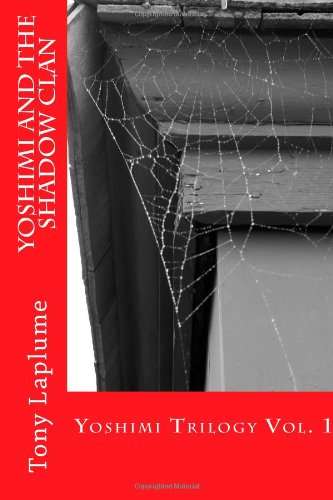
Yoshimi and the Shadow Clan


For the past year I've been following Pat Dilloway's devotion to his Scarlet Knight series on his eponymous blog.  The more I became aware that it was a series the more Pat's devotion intrigued me.  At first it was just about the one book, A Hero's Journey, but then he unveiled the rest of the books, which he is currently in the midst of releasing.

Now, there are certain parallels to what I've been doing.  Yes, Seven Thunders as I've been talking about it is very similar.  And the book this post is about is the first of a trilogy.  Yet I should note for the record that the complete Yoshimi trilogy was written well before last April, when I read Pat's blog for the first time.

Yet Pat is still something of an inspiration, and when I read A Hero's Journey for the first time, I didn't realize how closely it resembled Yoshimi and the Shadow Clan.  When I read Journey earlier this year, I called it, along with Martin Ingham's Curse of Selwood, I came to see it as a kind of young adult adventure, and when I reviewed it I'm not sure I expressed that well enough.  Young adult fiction is not something to feel bad about reading.  Even I've struggled with this perception in the past.  Most of it is inspired directly by popular fiction meant for anyone, though with themes that younger readers will appreciate.  Journey in fact features a young adult of a different kind, one who's moved on from high school but in her own mind maybe doesn't feel like she has.

When I wrote about Yoshimi, I wrote very specifically for the traditional young adult market, and yet while I was editing it I was surprised to find language that was in places very similar to Pat's and even Ingham's, characterizations that resonated in exactly the way I'd planned.  I tend to write very esoterically, and the whole point of Yoshimi was that she'd be my way to suppress that instinct.  This works really well in Yoshimi and the Shadow Clan, though in the concluding volumes I shift a little more into more familiar territory.  Which to my mind is a good thing.  If you like what you see in the first book, hopefully you'll be that much more interested and invested in what follows.

Pat spends the Scarlet Knight series deepening his mythology, which is exactly what you want to see in a series.  We're both budding writers looking for a way into the hearts of readers.  His dedication to Scarlet Knight was one of the main reasons I was finally able to overcome the dejection of what Yoshimi's original publishing fate was supposed to be.  Ingham plays a part here, too, because he released Selwood himself, the second in a series.

Yoshimi's story is all about finding a sense of forward momentum when everything seems to work against her.  Her publishing history has turned out to reflect that.

You can find Yoshimi and the Shadow Clan available at Amazon as a paperback and ebook.
Related Posts Plugin for WordPress, Blogger...