I'm currently reading Roberto Bolano's The Savage Detectives, which is a fictional account of the late author's own literary life experiences. Bolano died a decade ago this year, but it wasn't until about four years back, with the publication of his masterpiece 2666, that I took notice of him, and the Chilean writer subsequently became my all-time favorite novelist (supplanting Herman Melville, no less).
Bolano spent most of his time as a novelist musing on his own experiences, much as aspiring writers are always told to "write what they know." He considered himself first and foremost a poet, and it was in this mischievous form that he existed for the events depicted in Savage Detectives, the tenuous heart of a whole movement that never really happened although still accomplished its goal of being honest about itself, which was the whole point.
It's gotten me thinking about a number of things, both about my own experiences in literary communities and how I tend to write my own stories, if I indeed "write what I know."
As far as communities go, I've never quite been a Bolano, but to a certain extent maybe I have, if not quite a charismatic center then certainly the enigmatic figure who drifts in and out of writing circles. In college I was part of the poetry scene that coalesced around a couple of acquaintances who stumbled into some of the same classes together, which eventually led to the short-lived Hemlock literary journal. Since I wasn't part of the inner circle of that group, more like the narrator of the opening section of Savage Detectives, I would never be able to give a truly definitive account of those days, but it's still nice to look back on.
The Hemlock experience was something I enjoyed quite a bit, which led to the abortive Dead Letter Quarterly several years later, the product of acquaintances from a comic book site I wrote at for awhile, which led to the more successful Project Mayhem anthology I put together for my budding Mouldwarp Press imprint (if you're interested, you can still consider contributing to a follow-up).
In recent days the idea of a writing community has shifted to blogging buddies such as yourself and even former coworkers.
Part of what's made this such a roundabout experience for me is that I spent all my budding years as a writer not actually writing. In middle and high school, I developed my tools for world-building rather than writing, I guess believing that knowing a story is the first stage to writing it. By the time I started writing stories in earnest it took my some time to integrate the world-building, but at least gave me time to work on my storytelling. I knew I was a writer before I did any serious writing, which is perhaps why I exist much as Bolano did, as a literary romantic, and don't necessarily view it the same way that others of my ilk tend to, as something they do rather than something they are. I tend to shout at the opposition like Bolano, and this can sometimes make it hard to find kindred souls (people don't generally liked to be shouted at for some reason), whether or not they exist at all.
As far as writing trends go, I'm different from Bolano in that I don't tend toward extrapolations of my own experiences in the same literal sense so much as drawing from elements. For Modern Ark I imposed my relationship with my sister on a vampire story. In the current Pangaea plans, I've been modifying characters to be a bit more like Bolano, although the framework remains very much my own. All my stories are reflections from my perspective and aims for literature. Where Bolano tended to look at the world from an intimate vantage point, I lean toward expansive, which opens for more fantastical opportunities, although he's a writer who shares my need to represent myself in a more obvious way (once you know it's there) than I find in others, although certainly in some like Melville it's clearly there and adds layers of depth to the storytelling and for me defines what being a true writer is all about.
Saturday, October 12, 2013

Friday, October 4, 2013
The Kennedy Curse in my hands!
Today I received in the mail my complimentary contributor's copy of The Kennedy Curse, which features my short story, "The Cuban Exile Crisis."
Needless to say, excited!
The most exciting thing for me, as I've said a few times before, is that this marks the first time someone other than myself has published a story from my Space Corps saga. Space Corps is my sci-fi magnum opus, spanning an entire series of books, starting with a manuscript I completed earlier this year, Seven Thunders, which I will be shopping around starting as soon as I can muster the courage to do so.
The thing about "Cuban Exile Crisis" in particular is that it continues a curious impulse of mine recently to begin fleshing out a part of the saga that I'd previously left more or less alone, being the first human-Danab conflict. On my Space Corps page over at my writing blog, there are two others already, "Use Both Hands" and "Seventy-One and Counting" (it's also worth noting that both "Who Killed Iron Joe?" and "George Jackman and the Monastery at Burnside" both provide prelude material to Seven Thunders, the latter of which helping to inform elements of the story that I hadn't considered before). Heroes and incidents from the First Danab War keep popping up in these tales.
I figured in an anthology dedicated to the legacy of the Kennedys there was bound to be room for a future descendant who could find room to contribute.
You can purchase The Kennedy Curse here.
Needless to say, excited!
The most exciting thing for me, as I've said a few times before, is that this marks the first time someone other than myself has published a story from my Space Corps saga. Space Corps is my sci-fi magnum opus, spanning an entire series of books, starting with a manuscript I completed earlier this year, Seven Thunders, which I will be shopping around starting as soon as I can muster the courage to do so.
The thing about "Cuban Exile Crisis" in particular is that it continues a curious impulse of mine recently to begin fleshing out a part of the saga that I'd previously left more or less alone, being the first human-Danab conflict. On my Space Corps page over at my writing blog, there are two others already, "Use Both Hands" and "Seventy-One and Counting" (it's also worth noting that both "Who Killed Iron Joe?" and "George Jackman and the Monastery at Burnside" both provide prelude material to Seven Thunders, the latter of which helping to inform elements of the story that I hadn't considered before). Heroes and incidents from the First Danab War keep popping up in these tales.
I figured in an anthology dedicated to the legacy of the Kennedys there was bound to be room for a future descendant who could find room to contribute.
You can purchase The Kennedy Curse here.
Wednesday, October 2, 2013
The Insecure Writer's Support Group October 2013

I've spent a long enough time not participating in this thing, so I figured I'd finally join. And such good timing! The IWSG now has its very own site. It's the brainchild of ninja captain Alex Cavanaugh and meets on the first Wednesday of every month. As for the purpose? It's the porpoise, of course. (He's in the water across from the lighthouse. He took the picture.)
For my inaugural post, I'm going to talk about clarity. Recently I've been exchanging thoughts on the film Immortals with A. Lee Martinez on Facebook. Why I'm talking with Martinez, the author of such books as Divine Misfortune, is because of Pat Dilloway, who has latched onto the author. Martinez recently saw Immortals presumably for the first time, and thought it was a hot mess. The film, from visionary director Tarsem (best work: The Fall), was originally released in 2011, and is a more recent version of the sword-and-sandal epic resurrected by Ridley Scott's Gladiator in 2000 and also exemplified by Zack Snyder's 300 from 2007.
Now, even though Gladiator won a Best Picture from the Oscars, most people these days still think of 300 as the definitive modern example of this genre of movies, even though Gerard Butler, the star of the film, is equally considered by most people to be merely a more histrionic version of Russell Crowe, who starred in the Scott picture. Immortals was Henry Cavill's first big role, but chances are people were thinking then and will still now and for the foreseeable future consider this past summer's Man of Steel (where he played, y'know, Superman) for that distinction.
Immortals is one of many, many films that were released in the wake of 300 to adopt a similar aesthetic presentation. In fact, most people seem to have assumed the whole reason it was made at all was to capture the very same audience, and perhaps for studio bosses that was exactly the case. And yet, knowing Tarsem as I do, I could never view it that way.
The film, as Martinez suggests in his vehement and negative opinion, can easily be said to be a hot mess, in one viewing. Even though I have an abiding love for Tarsem, that's pretty much how I saw it myself the first time. It was virtually impenetrable, or in other words lacked clarity. Cavill isn't nearly as striking a presence as Butler is in 300, and he's rarely in a position as Crowe is for the majority of Gladiator to command attention. The roles are very different. If anything, Cavill is far more like Sam Worthington in Clash of the Titans, a reluctant hero who has to crawl all the way to the top (besides being a generally heroic and capable kind of guy to begin with). (Given that few people seem to like the Titans remake, this is not such a great allusion.)
No, the big star of Immortals is Mickey Rourke, who approaches the villain role much as Butler does the hero role in 300. There's also John Hurt, who has one of the most distinctive voices in film today, who acts as narrator and one of the guises of Zeus, as well as the lovely Freida Pinto in one of her early post-Slumdog Millionaire roles. (She is was and always will be the best thing about that movie.) The fourth and fifth leads go to Stephen Dorff and Luke Evans.
The gist of the story is that Rourke is a power mad monarch who wants to declare war on the gods by unleashing their ancient rivals (who just so happen to be...the Titans). Naturally Zeus isn't too keen to see this happen, so he gently nudges Cavill into position to stop this from happening. The problem is that in the chaos that follows in the wake of Rourke's maneuvering, Cavill ends up further from his goal than is convenient. By the time he's ready, it's too late and the big battle at the end of the film has already provoked tragedy, including the deaths of several gods, which finally forces Zeus to break his own vow of noninterference. It is indeed Cavill who stops Rourke, thus being the hero Zeus thought he could be, but the catastrophe remains. But then again, the original war between the gods wasn't so great either, and once the Titans, like the kraken, are unleashed there's only so much damage control possible.
The visuals do indeed evoke 300, but there are the telltale signs of Tarsem all around. (He began his career in music videos, but called greater attention to himself with The Cell, in which Jennifer Lopez traverses a surreal landscape. In fact, Tarsem is always immersing himself in those. It's the story he tells every time, and like a great storyteller is always finding new ways to do so.)
As far as clarity goes, however, there's not so much of that going around, at least initially. For this reason, it can seem unsatisfying and even a gross case of bad filmmaking in general. In such cases it's easy to extrapolate that the story simply didn't work or was executed poorly, or that characters behaved stupidly. All these things are the reaction of someone who failed to connect with the presented experience.
So why am I going on and on about this in a post that's supposed to be about my specific writing experience? Well, for one thing I recently had another look at one particular chapter in my manuscript for Minor Contracts, one of three I have floating in the air. I was unsatisfied with the way I'd written it. And I went back to reservations I've had about the opening chapter. And I started to think, maybe I have to write the whole thing over again. Generally, I hate even the idea of doing that. I will sometimes have to start over again, but I've never even thought about doing that with a whole manuscript. With the Modern Ark manuscript, I haven't thought about doing that sort of thing too much, because it's a whole house of cards, almost every chapter doing something entirely different. If I move one piece, the whole thing could collapse, and I've already monkeyed around with the opening chapter of that one several times. I'm of the idea that what was going through my mind when I wrote the thing in the first place is more than likely the best version. Anything else is just another version. If the due diligence was performed in the original conception, you should be fine.
Now, certainly editing is a key thing to consider. In movies editing can affect everything. Oliver Stone has four cuts of Alexander (my favorite movie, and another sword-and-sandal epic), for instance. Studio heads used to chuckle wildly as they hacked apart Orson Welles' work. With someone like Orson Welles, you change the shape of his work and you most definitely change the whole thing. (I'm not claiming to be Orson Welles, mind you.)
And I'm just talking about things I've already written. Twice now in the past month I've already radically altered the course of the next manuscript I'll be writing, In the Land of Pangaea, even thinking of alternate titles (which happens to my stories frequently anyway, even years after I've completed first drafts). Thinking of those changes and the changes I could make to Minor Contracts doesn't even begin to take into account clarity.
Because I'm always wondering how clear my stories are. Most of the writers around me strive almost single-mindedly for clarity. Sometimes I've taken that to patronizingly calling their work simplistic. And yet most stories are like that. When it's anything but it's either quickly forgotten or a classic. (And no, I'm not going to say I write classics. That's for history to decide. And here you understand that I'm speaking in the voice of Dr. Sheldon Cooper. Which reminds me, bears are terrifying.)
When I'm looking at my own work and not even considering clarity, I can understand why I look at a movie like Immortals differently than A. Lee Martinez. Clarity is clearly one of his priorities. Me, I can deal with a little mess. This isn't to say that I'll accept anything. There's really is such a thing as a hot mess, when someone's reach has exceeded their grasp. I don't think that's the case with Immortals. It would be hard for someone like Tarsem to do that after nailing something as brilliant as The Fall.
So when I look at my own writing, and worry about specific elements or passages, I'm worrying less about how they will ultimately work and more about how they fit into the greater tapestry. There's got to be a unifying imperative. In Immortals it was always John Hurt and and my belief in the abilities of Tarsem. Did I convince myself the movie worked because I wanted it to work? That will always be the counterargument.
But I don't think so.
Wednesday, September 18, 2013
The Kennedy Curse releases 10/1/13!
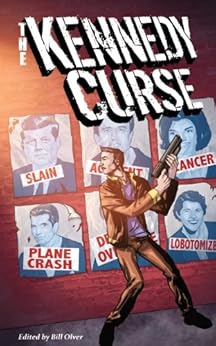
Of course, it's not just Space Corps, my sprawling space opera epic, that interests me about the story or the anthology, but my long interest in JFK and his whole family, something I picked up from my mother and I've enthusiastically continued. I'm one of those people who believes in the conspiracy theory, that the events that will be commemorated for their fiftieth anniversary this coming November may not be exactly how history remembers them.
But my story isn't about that. It's set in the future, actually, and as the title suggests occurs in Cuba, where a descendant has ended up. She finds herself entangled in another international incident, although this one unlike the other one comes in the midst of a full-blown war the whole world is facing. In the Space Corps universe this is humanity's introduction to the Danab menace. The story doesn't worry too much about this war so much as the main character's troubles as she attempts to figure out where she stands and what if anything she can do about it.
And other people contribute other stories, too! Here's the Amazon link.
The Complete Yoshimi comes to paperback
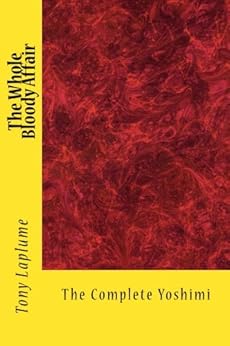
That would be the cover for The Whole Bloody Affair, a.k.a. The Complete Yoshimi.
Available here in paperback!
For those unfamiliar with Yoshimi and her fictional and well as publishing history, here's a brief recap: The warrior orphan was originally conceived at the behest of a friend's budding publishing label. They were just getting into the business of releasing novels at the time, and I saw this as an opportunity. I don't tend to write terrifically straightforward fiction (in other words, I'm more of a literary guy than James Patterson, or in other other words I'm not usually very commercial in the traditional sense). Yoshimi's story was immediately cast in the vein of things I'd enjoyed, in books and film (and her name taken from a Flaming Lips album), the revenge plot.
The complete story is very similar to Harry Potter and the Prisoner of Azkaban, the third in that series, while it borrows significantly from Quentin Tarantino and Uma Thurman's Kill Bill. The truth isn't always what it seems, and Yoshimi has a lot of people to defeat along the way. (So, she's also similar to Scott Pilgrim!)
The small publisher folded in the midst of the planning stages for the book's release.
Earlier this year I started and intended to release each of the book's three volumes separately. Then a lot of things very rapidly changed for me, and I lost the original schedule. When things finally settled down again, I had the impulse to release the whole story in a single volume, as I had intended to at the conclusion of the serialization. And so here we are.
As for the cover, I've pretty much been sticking to the available templates at CreateSpace, and that's true again here. The color scheme is an homage to the iconic posters for Kill Bill, Vol. 1 while also evoking the red pattern for the second (here it takes the shape of an ominous field of blood).
As to whether or not I'm trying to trick unsuspecting consumers into buying my book by using a phrase closely associated with Kill Bill, well, as far as I figure, Tarantino is in no rush to use it, and it has a nice ring. Why not? (Then again, perhaps I'll find out.)
...Of course, it's my fervent wish that this is the very last book I'll ever have to release myself, and I hope I'm going out with a bang.
Tuesday, September 17, 2013
CassaStorm brewing...
Today's the release of Alex J. Cavanaugh's CassaStorm!
...Although I suspect that if you're visiting this blog you probably know about it already!
...Although I suspect that if you're visiting this blog you probably know about it already!
Subscribe to:
Posts (Atom)
